

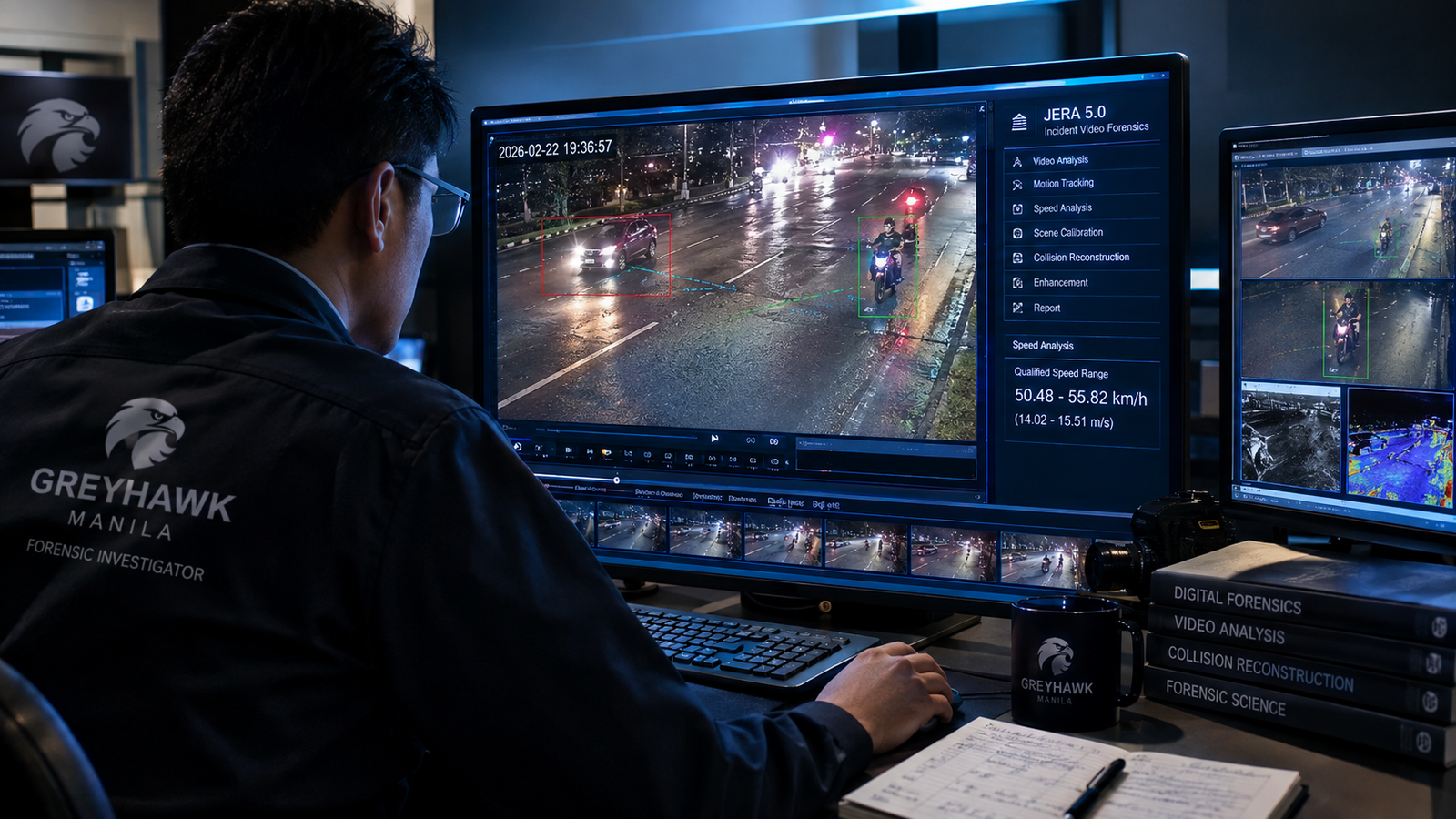
Proven Digital Forensics From CCTV to Measurable Vehicle-Collision Evidence
When CCTV Becomes Forensic Evidence
A vehicle collision can unfold in only a few seconds.
By the time investigators arrive, Greyhawk Manila notes, vehicles may have been moved.
Additionally, skid marks may begin to disappear, witnesses may remember events differently, and critical details may no longer be visible.
Digital video can preserve a record of the event—but preserving video is only the beginning.
In this Greyhawk Manila case-study, a collision investigation demonstrates how modern Incident Video Forensics can analyze CCTV footage. Additionally, it covers frame-by-frame analysis, vehicle tracking, road-marking study, skid-mark examination, scene calibration, speed reconstruction, video enhancement, and evidence correlation.
The investigation was structured using Jera 5.0 Incident Video Forensics, Greyhawk’s forensic case-management and video-analysis environment.
The Forensic Question
The objective was not simply to determine “what happened in the video?”
The investigation asked a series of measurable questions:
- How were the vehicles moving before the collision?
- What was their direction and trajectory?
- Can pre-impact speed be calculated?
- Was braking observable?
- Are skid or tire marks present?
- What do the road markings establish?
- Was the roadway visibly wet or potentially contaminated?
- Where did the apparent impact occur?
- What happened immediately before and after impact?
- Are there periods of obstruction or missing visibility?
- Can enhancement reveal additional observable details?
- Which findings are directly observed and which require inference?
These questions are important because forensic examination must distinguish what the evidence shows from what an examiner believes may have occurred.
1. Evidence Preservation Comes First
The original CCTV file is treated as forensic evidence.
Before enhancement or reconstruction, the evidence is registered in Jera 5.0 and subjected to integrity examination.
The workflow is:
Original Video → Hash Verification → Preservation → Working Copy → Examination → Derivatives → Findings → Report
The original file is not edited.
Instead, Jera 5.0 maintains separate forensic derivatives for:
- Frame extraction;
- Enhancement;
- Cropping;
- Stabilization;
- Analytical annotations;
- Reconstruction exhibits; and
- Report illustrations.
This creates a traceable relationship between the final exhibit and its original source.
2. Technical Video Examination
The first stage examines the actual characteristics of the recording.
The forensic examiner evaluates:
- Resolution;
- Frame rate;
- Frame count;
- Duration;
- Codec;
- Container;
- Bitrate;
- Audio characteristics;
- Timestamp information;
- Embedded metadata;
- File-system metadata;
- Encoding characteristics;
- Possible transcoding;
- Frame irregularities; and
- Video continuity.
A critical distinction is made between metadata time and incident time.
A timestamp displayed by a CCTV system should not automatically be treated as independently verified real-world time without examining how the camera system generated and maintained that timestamp.
3. Frame-by-Frame Reconstruction
A collision that appears instantaneous during normal playback can contain numerous analytical events when examined frame by frame.
Jera 5.0 allows investigators to move through the sequence:
Frame → Frame → Frame
while recording:
- Vehicle position;
- Direction;
- Relative movement;
- Braking indicators;
- Steering changes;
- Collision indicators;
- Debris movement;
- Post-impact trajectory; and
- Camera obstructions.
The examiner can review the sequence at reduced playback speeds and identify key frames.
Key-frame categories
PRE-IMPACT
The last clearly observable vehicle positions before the collision.
APPROACH
Vehicle movement toward the conflict area.
APPARENT IMPACT
The frame or sequence in which contact appears to occur.
POST-IMPACT
Vehicle separation and subsequent movement.
4. Vehicle Tracking
Each vehicle is treated as an independent forensic subject.
For example:
Vehicle A
- First appearance;
- Direction of travel;
- Lane position;
- Approach trajectory;
- Braking indicators;
- Pre-impact position;
- Apparent impact position;
- Post-impact trajectory.
Vehicle B
The same analytical process is performed independently.
This avoids prematurely assigning identity, fault, or responsibility to a vehicle based solely on appearance.
5. Road-Mark Analysis
The roadway itself can become a measurement reference.
Investigators examine visible:
- Center lines;
- Lane boundaries;
- Edge lines;
- Stop lines;
- Crosswalks;
- Shoulder areas;
- Curbs;
- Road edges;
- Intersections;
- Road curvature; and
- Other fixed scene features.
Where reliable dimensions are available, these features can assist with scene calibration.
However, a critical forensic principle applies:
A line visible in CCTV is not automatically a known distance.
Actual measurements should come from reliable sources such as field measurements, calibrated maps, engineering documentation, or another defensible measurement methodology.
6. Skid-Mark and Tire-Mark Analysis
Where physical scene evidence is available, Greyhawk can correlate the CCTV sequence with photographs and measurements of:
- Skid marks;
- Tire marks;
- Yaw marks;
- Scuff marks;
- Gouges;
- Scrapes;
- Debris;
- Fluid trails; and
- Vehicle rest positions.
The investigation can then compare the physical evidence with the movement observed in the CCTV.
For example:
CCTV braking sequence
↓
Visible vehicle trajectory
↓
Physical tire/skid mark
↓
Measured distance
↓
Collision position
This creates an evidence-correlation pathway rather than relying on a single source.
7. Speed Reconstruction
One of the most important elements of collision video forensics is determining whether speed can be reliably calculated.
The fundamental relationship is:
Speed = Distance ÷ Time
But a defensible calculation requires more than simply watching a vehicle move quickly.
Jera 5.0 requires:
- Start frame;
- End frame;
- Verified frame timing;
- Vehicle identification;
- Measured distance;
- Reference points;
- Scene calibration;
- Vehicle trajectory;
- Perspective considerations; and
- Measurement uncertainty.
The primary calculation is normally:
PRE-IMPACT SPEED
rather than attempting to use post-impact movement as a substitute for the vehicle’s original speed.
If adequate spatial calibration does not exist, the correct forensic result may be:
Speed cannot be reliably determined from the available evidence.
That is a valid forensic finding.
8. Road Surface Conditions
Road conditions can influence vehicle braking and handling.
The examination may document visible indicators of:
- Rain;
- Wet pavement;
- Standing water;
- Road sheen;
- Tire spray;
- Mud;
- Gravel;
- Sand;
- Oil or other contamination;
- Poor drainage; and
- Reduced visibility.
However, visual evidence of a wet roadway does not by itself establish a numerical coefficient of friction.
A friction-related reconstruction requires appropriate physical and engineering evidence.
This distinction prevents the forensic report from converting an observation into an unsupported scientific measurement.
9. Impact Reconstruction
Jera 5.0 can combine the available evidence into a visual reconstruction.
The examiner can plot:
Vehicle trajectory
→
Conflict area
→
Apparent collision point
→
Post-impact movement
→
Final visible position
The reconstruction can also incorporate:
- Road markings;
- Skid marks;
- Vehicle photographs;
- Debris;
- Fixed structures;
- Scene measurements; and
- Relevant video frames.
The purpose is not to create an attractive animation.
The purpose is to create a traceable analytical model connected to evidence.
10. Video Enhancement
Original CCTV footage may contain difficult lighting, compression, noise or motion-related limitations.
Greyhawk can generate separate analytical derivatives using techniques such as:
- Brightness adjustment;
- Contrast adjustment;
- Gamma adjustment;
- Noise reduction;
- Sharpening;
- Stabilization;
- Cropping;
- Resizing;
- Grayscale conversion;
- Temporal analysis;
- Frame comparison; and
- Other validated processing techniques.
Every enhancement remains separate from the original evidence.
Example
Original Evidence
→ Working Copy
→ Enhanced Derivative
→ Extracted Forensic Frame
→ Annotated Exhibit
The examiner can therefore show exactly which processing stage produced a particular exhibit.
11. Motion and Peak Review
A particularly useful capability of Incident Video Forensics is the ability to examine the motion sequence, rather than relying on individual screenshots.
Jera 5.0 allows investigators to review:
- Normal playback;
- Slow motion;
- Frame-by-frame motion;
- Reverse review;
- Key frames;
- Motion transitions;
- Vehicle trajectories; and
- Apparent impact intervals.
This is important because a single frame can be misleading when separated from the frames immediately before and after it.
A forensic examiner therefore reviews both:
Frame Evidence
and
Temporal Sequence
12. Occlusion Analysis
Not every part of a collision may be visible.
Another vehicle may block the camera.
A pedestrian may obstruct the view.
A vehicle may pass in front of the collision.
The camera may have:
- Limited field of view;
- Motion blur;
- Compression artifacts;
- Low-light limitations;
- Exposure problems; or
- Physical obstructions.
Jera 5.0 records these limitations.
Instead of filling an invisible portion of the sequence with assumptions, the report identifies:
NOT DETERMINABLE FROM AVAILABLE VIDEO
This is an important part of forensic integrity.
13. AI-Assisted Video Forensics
Modern forensic platforms can use artificial intelligence to assist investigators with:
- Candidate event detection;
- Object tracking;
- Frame descriptions;
- Timeline organization;
- Motion clustering;
- Evidence correlation;
- Candidate key-frame identification; and
- Report preparation.
But AI output must remain subject to human forensic examination.
Greyhawk therefore distinguishes:
AI-ASSISTED ANALYSIS
from
EXAMINER-VERIFIED FINDING
AI should not be allowed to invent:
- Missing events;
- Exact speed;
- Distance;
- Identity;
- Intent;
- Negligence;
- Fault; or
- Evidence outside the camera’s view.
14. Evidence Classification
Every important finding can be classified within the Jera 5.0 workflow.
OBSERVED
Directly visible in the evidence.
CORROBORATED
Supported by independent evidence.
INFERRED
A reasoned interpretation based on observable evidence.
NOT DETERMINABLE
The evidence is insufficient to establish the proposition reliably.
This classification helps prevent an analytical interpretation from being presented as an established fact.
15. The Jera 5.0 Evidence Chain
The investigation can be represented as:
EVIDENCE
↓
AUTHENTICATION
↓
FRAME ANALYSIS
↓
TIMELINE
↓
VEHICLE TRACKING
↓
SCENE CALIBRATION
↓
ROAD ANALYSIS
↓
SKID-MARK CORRELATION
↓
SPEED ANALYSIS
↓
IMPACT RECONSTRUCTION
↓
VIDEO ENHANCEMENT
↓
MOTION / PEAK REVIEW
↓
EVIDENCE CORRELATION
↓
FORENSIC FINDINGS
↓
PEER REVIEW
↓
FINAL REPORT
This is the central concept behind Greyhawk’s Incident Video Forensics workflow.
16. What the Final Report Can Establish
Depending on the quality and completeness of the evidence, the final report may establish:
- Observable vehicle movement;
- Direction of travel;
- Relative positioning;
- Measured distances;
- Frame-derived elapsed time;
- Qualified speed estimates;
- Braking indicators;
- Road-mark relationships;
- Skid/tire-mark relationships;
- Apparent collision sequence;
- Post-impact movement;
- Video visibility limitations;
- Enhancement results;
- Evidence correlations; and
- Uncertainties.
The report should also clearly identify what cannot be established.
For example:
The available CCTV evidence may demonstrate vehicle movement and an apparent collision sequence, while the precise subjective perception, intent, negligence, or legal responsibility of an individual remains outside the determination of video forensic examination alone.
17. Why Digital Forensics Matters in Collision Cases
Traditional collision investigation relies heavily on:
- Physical scene examination;
- Measurements;
- Vehicle inspection;
- Witness statements;
- Photographs;
- Road conditions; and
- Accident reconstruction.
Digital video adds another evidentiary layer.
It provides a time-based record of observable events.
When properly preserved and analyzed, CCTV can be correlated with physical evidence to answer questions that a photograph alone cannot.
The objective is not to make the video say more than it actually contains.
The objective is to extract the maximum reliable information from the evidence while preserving its limitations.
Greyhawk Manila’s Forensic Approach
PIXELS → FRAMES → MOTION → MEASUREMENTS → RECONSTRUCTION → FINDINGS
With Jera 5.0 Incident Video Forensics, Greyhawk Manila brings these stages into a controlled forensic workflow.
The platform is designed to connect:
Digital Evidence
Video Authentication
Frame Analysis
Motion Analysis
Scene Calibration
Road-Mark Analysis
Skid-Mark Correlation
Speed Reconstruction
Impact Analysis
Video Enhancement
AI-Assisted Examination
Evidence Correlation
Chain of Custody
Forensic Reporting
Conclusion
A collision video should not be treated simply as something to watch.
It can be treated as a digital evidence source capable of forensic examination.
The strongest analysis combines the recording with measurable scene evidence, documented methodology, reproducible processing and clearly defined limitations.
Through Jera 5.0 Incident Video Forensics, Greyhawk Manila’s objective is to transform raw video into a structured forensic examination in which every significant conclusion can be traced back to its underlying evidence.
Greyhawk Manila — From Digital Evidence to Defensible Forensic Findings.
Category: Case Study
Primary Service: Digital Forensics / Incident Video Forensics
Platform: Jera 5.0
Website: Greyhawk Forensics & Cybersecurity