

When the Platform Isn’t Breached: What the BigCommerce–Ribon Incident Reveals About Third-Party Risk
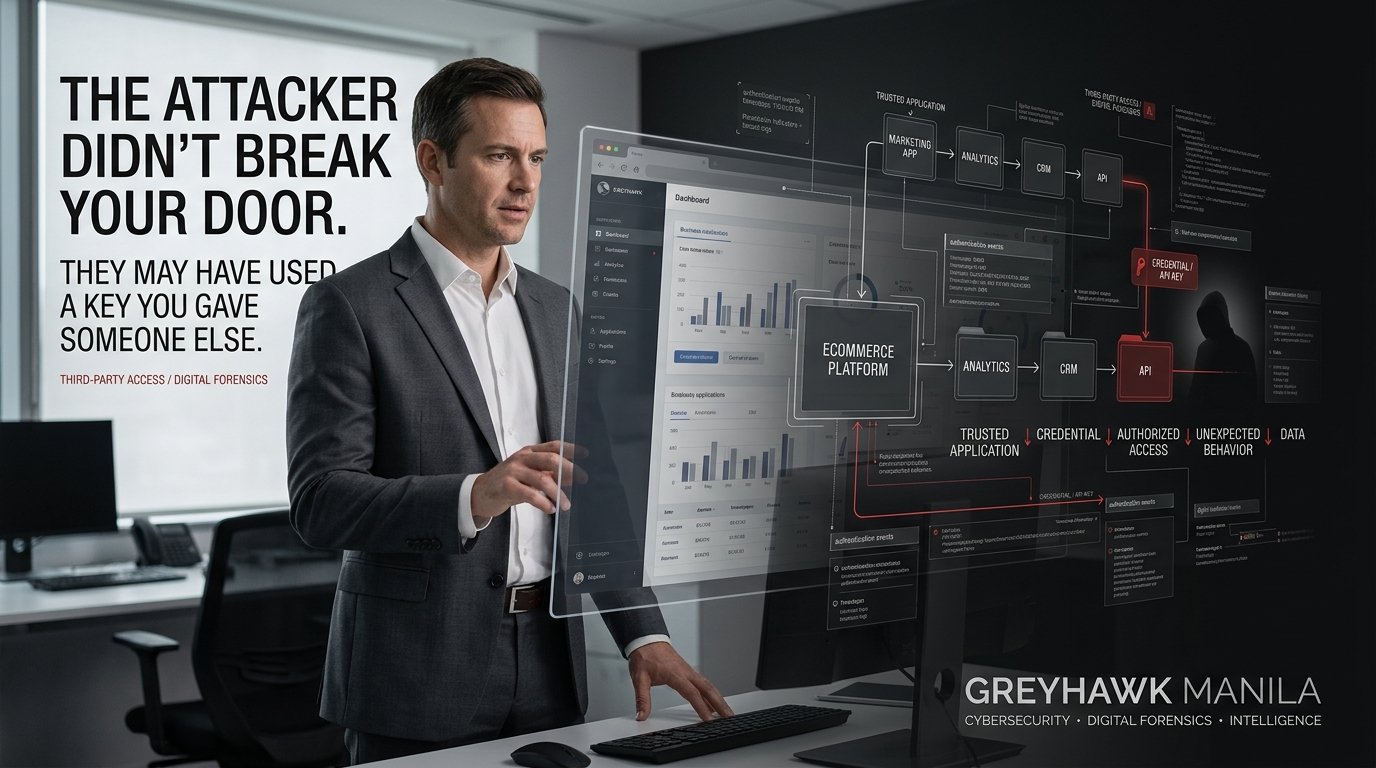
The BigCommerce–Ribon incident shows that an organization’s core platform can remain uncompromised while compromised third-party credentials become the pathway to customer data. For organizations relying on third-party applications, integrations, and API access, the more important question may not be whether the platform was breached, but what legitimate access was being used, by whom, and what happened after that access was obtained.
Sometimes, it begins with something you deliberately connected to it. That distinction is at the center of the recent BigCommerce–Ribon incident, in which attackers reportedly compromised credentials associated with third-party applications and used those credentials to access customer information in affected merchant environments.
The incident raises a much bigger question for organizations operating in increasingly interconnected digital ecosystems:
How much of your security actually depends on the security of someone else?
What happened?
According to reporting from SecurityWeek and subsequent reporting from BigCommerce and other sources, attackers compromised an application key associated with Ribon, a third-party application used within the BigCommerce ecosystem.
The attackers reportedly had access between September 13 and September 17, 2026.
During that period, customer information was accessed from affected merchant environments. Reported information included names, email addresses, phone numbers and shipping addresses.
BigCommerce subsequently confirmed that credentials belonging to the Ribon and Ribon 1.5 applications had been compromised.
The company stated that the attackers used the compromised credentials to inject malicious scripts into a limited number of merchant storefronts.
BigCommerce also emphasized an important distinction:
Its core platform was not itself breached.
The incident involved compromised credentials belonging to a third-party application.
BigCommerce removed the affected applications from impacted stores, revoked the attackers’ access and notified affected merchants. It also provided log data to assist the developer’s investigation.
That distinction matters.
Because saying simply “BigCommerce was hacked” would remove one of the most important lessons from the incident.
The attack surface was bigger than the platform
Modern organizations rarely operate on one system.
An ecommerce company might have:
- an ecommerce platform
- payment providers
- analytics tools
- customer-support software
- marketing platforms
- personalization tools
- inventory systems
- shipping integrations
- CRM systems
- advertising platforms
- plugins and applications
- APIs connecting everything together
Each connection can introduce another identity, credential, permission set or trust relationship.
The organization may have carefully secured its primary platform while overlooking the security posture of the applications that have been granted access to it.
This is the essence of third-party and supply-chain risk.
Your system can be secure while an authorized connection into your system becomes the pathway to your data.
The credential becomes the door
One of the most important elements in this incident is the compromised application credential.
Credentials are not inherently dangerous.
They exist because applications need to authenticate and perform legitimate functions.
The security problem emerges when a credential is:
stolen → trusted → sufficiently privileged → used by someone else.
From the system’s perspective, an attacker using valid credentials may not initially look like an attacker.
The credential may be legitimate.
The application may be legitimate.
The API request may be technically valid.
The problem is the person—or system—now operating behind that legitimate identity.
BigCommerce’s own developer documentation illustrates why credential governance matters. Its API ecosystem includes store-level, app-level and account-level credentials, with permissions determining what resources an authenticated application can access. BigCommerce specifically advises organizations to protect secrets and revoke credentials when compromise is suspected.
This leads to an important investigative question:
Are you monitoring what an identity is doing, or are you only checking whether the identity is legitimate?
Those are not the same thing.
The overlooked question: what happened before detection?
Another important part of an investigation is the timeline.
According to reporting, the compromised Ribon credential was used between September 13 and September 17, with the key revoked after the misuse was discovered.
SecurityWeek reported that attackers accessed customer information during that window, while Master of Malt described the information being retrieved progressively.
For investigators, that means the question isn’t simply:
“Was data accessed?”
The deeper questions become:
- When did the credential first become compromised?
- How was it obtained?
- When was the first abnormal activity observed?
- Which stores were accessible?
- Which API resources were requested?
- What data was retrieved?
- How frequently were requests made?
- Did the activity resemble normal application behavior?
- Which requests were legitimate?
- Which requests deviated from the application’s normal pattern?
- What happened immediately before and after the compromise?
- What evidence remains available for reconstruction?
Those questions turn an incident report into an investigation.
Why logs matter
Once a third-party credential is compromised, the investigation depends heavily on available evidence.
- Authentication records.
- API activity.
- Application logs.
- Storefront changes.
- Script injections.
- Credential events.
- Timestamps.
- IP addresses.
- User-agent information.
- Access patterns.
- Changes in application behavior.
Individually, each piece may appear insignificant. Together, they can help reconstruct the sequence of events.
This is where cybersecurity and digital forensics begin to overlap.
Cybersecurity asks:
“How do we prevent this from happening again?“
Digital forensics asks:
“What actually happened?“
Intelligence analysis adds another layer:
“What does the pattern tell us about the people, systems and relationships involved?“
The uncomfortable part of third-party trust
Organizations frequently perform security reviews when they onboard vendors.
They ask:
Is this vendor secure?
But security should not necessarily end at on-boarding.
- The relationship changes.
- Applications change.
- Permissions change.
- Developers change.
- Credentials change.
- Infrastructure changes.
- Ownership can change.
- Integrations multiply.
A vendor that was low-risk two years ago may have a very different exposure today.
That means third-party risk should be treated as a living relationship, not a one-time checkbox.
What organizations should investigate
The BigCommerce incident provides a practical opportunity for organizations to examine their own third-party ecosystem.
1. Map every external connection
Do you know every application, integration, API and service that can access your environment?
If the answer is “probably,” that is not the same as knowing.
2. Understand permissions
Don’t only ask whether an application needs access.
Ask:
What exactly can it access?
Least privilege matters because a compromised credential can only do as much damage as the access behind it permits.
3. Monitor behavior
A legitimate credential can be used illegitimately.
Monitoring therefore needs to consider behavior—not simply identity.
4. Know how credentials are revoked
When an application is compromised, how quickly can its access be removed?
Who has authority?
What systems need to be changed?
What dependent services might break?
5. Preserve evidence
If something abnormal happens, organizations need enough logs and records to reconstruct the event.
Without sufficient evidence, organizations may know that something happened without knowing exactly how it happened.
6. Investigate the ecosystem—not just the endpoint
The compromised system may be only one part of the story.
Investigators should examine the relationships surrounding it.
Application → credential → permission → platform → data → user → downstream systems
That chain can reveal where the actual exposure occurred.
The bigger lesson
The most important lesson from this incident isn’t that third-party applications are inherently unsafe.
Organizations depend on third-party technology every day.
The lesson is that trust creates attack paths.
When you connect an application to your environment, you are not simply adding functionality.
You are also creating:
- a relationship,
- an identity,
- a permission set,
- a potential attack path
- relationship
- and ultimately, another part of your security boundary.
That is why cybersecurity cannot stop at the perimeter.
And digital forensics cannot stop at the compromised machine.
Sometimes the investigation begins by asking a much simpler question:
Who—and what—did we allow through the door?
Greyhawk Manila Perspective
At Greyhawk Manila, we look beyond the obvious incident.
We examine the relationships between systems, people, credentials, access, behavior and evidence to understand how an incident unfolded—and what organizations can learn from it.
Because the system you are protecting may not be where the story begins.
Cybersecurity • Digital Forensics • Intelligence
Sources: SecurityWeek reporting published September 22, 2026; BigCommerce developer documentation; BleepingComputer reporting published September 21, 2026; ThaiCERT reporting published September 23, 2026. Details may evolve as investigations continue.
- The Laptop That Looks Fine Is Usually the One That Matters
- Four Kinds of Trust, Four Ways They’re Being Broken
- The Gyazo Data Breach: When “Metadata” Becomes a Security Problem
- When the Attacker Has AI: Inside the Campaign Targeting Online Retailers
- When the Platform Isn’t Breached: What the BigCommerce–Ribon Incident Reveals About Third-Party Risk