
The Greyhawk Certified Digital Forensics Practitioner (GCDFP) is an elite, globally competitive, and APAC-aligned professional certification program designed for modern digital forensics investigators, cybersecurity professionals, and law enforcement analysts. Developed by Greyhawk Forensics, the program bridges the gap between traditional investigative methodologies and the staggering realities of modern, decentralized data landscapes
Rooted in ISO/IEC 27001 ISMS certified operations and aligned with international investigative standards as well as regional APAC statutory requirements (such as India IT Act Section 65B and Singapore Evidence Act Section 10), the GCDFP equips practitioners with the technical mastery and legal precision required to produce court-admissible evidence across multi-jurisdictional environments.
Master international legal frameworks, ISO/IEC 27037 standards, and the ACPO Golden Rules of digital evidence.
Establish the professional role of the forensic examiner as an independent, objective scientist and officer of the court.
Explore regional evidentiary requirements, including cross-border routing protocols and mutual legal assistance.
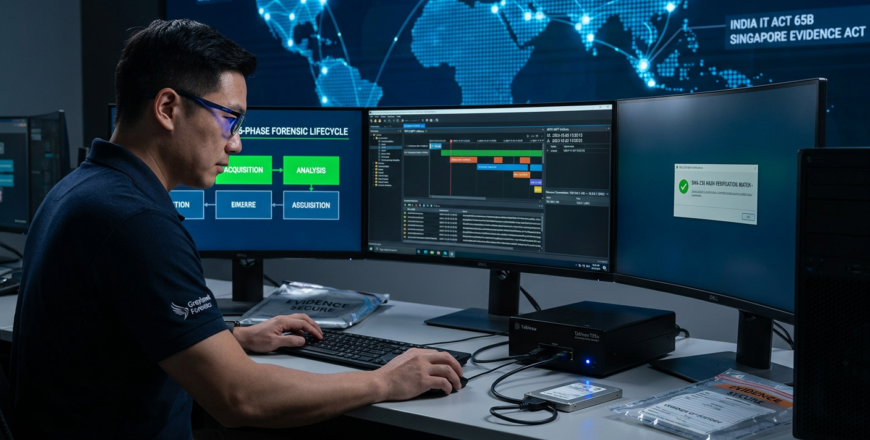
Deep-dive into the six-phase lifecycle: Identification, Collection, Acquisition, Preservation, Analysis, and Reporting.
Execute first-responder protocols, manage volatile data hierarchies, and apply Faraday isolation for mobile and network-connected devices.
Deploy hardware write-blockers and generate SHA-256 cryptographic hashes to prove bit-for-bit integrity and maintain an unbroken chain of custody.
Navigate complex mobile operating systems, bypass OEM bootloaders, and extract evidentiary artifacts from smartphones and IoT devices.
Perform cloud log extraction, analyze packet captures (PCAP), and map decentralized network traffic.
Analyze Microsoft NTFS and FAT file system architectures, including $MFT record attributes and MACB timestamps.
Examine Update Sequence Number (USN) change journals and Volume Shadow Copies (VSCs) for historical file modifications.
Identify and counter advanced anti-forensic techniques, including timestomping, secure file wiping, encryption, and data obfuscation.
Translate complex technical artifacts and raw binary data into clear, objective, and court-admissible forensic reports.
Undergo rigorous objectivity auditing to ensure findings withstand intense defense cross-examination.
Deploy into the Valhalla Virtual Learning Environment to solve simulated multi-terabyte corporate network breaches and ransomware incidents.
Participate in mock trial cross-examination exercises and transition directly into professional talent-to-placement pipelines.
To successfully achieve the GCDFP designation, candidates must pass a rigorous 100-question comprehensive board examination administered through the Greyhawk Secured Exam System. The exam is structured across four core domain modules to test both practical scenario application and deep technical knowledge:
Core Focus: Evolution of digital forensics from the 1970s hobbyist era to the modern AI era, examiner ethics, the hybrid professional profile (Scientist, Technologist, Investigator), and the 6-phase forensic lifecycle.
Assessment Style: Scenario-based decision making and knowledge-based verification of investigative methodologies.
Core Focus: The four pillars of evidence admissibility (Relevance, Authenticity, Integrity, Reliability), APAC compliance (India IT Act Section 65B, Singapore Evidence Act Section 10), ASEAN MLAT cross-border routing, and tamper-evident chain of custody preservation.
Assessment Style: Procedural compliance analysis, legal admissibility evaluations, and field-handling scenarios.
Core Focus: First responder safety duties, the technical hierarchy of the Order of Volatility, live versus dead acquisition protocols, hardware vs. software write-blockers, Faraday bag isolation, and SHA-256 cryptographic hash validation.
Assessment Style: Practical first-response triage scenarios and technical acquisition mechanics.
Core Focus: NTFS and FAT32/exFAT architecture, Master File Table ($MFT) attribute parsing, MACB timestamps, USN change journals, Volume Shadow Copies (VSCs), slack space, unallocated space, and signature-based file carving.
Assessment Style: Technical artifact interpretation, file system structure analysis, and data recovery problem-solving.
Greyhawk Secured Exam System: All quizzes, midterms, and the 100-question board exam utilize a proprietary portal featuring active virtual machine blocking, secondary monitor restriction, randomized question banks, and real-time behavioral anomaly monitoring.
Biometric Security Integration: Access to high-security operational nodes and board exams within the Valhalla VLE requires facial recognition and hand biometrics verification.
Cryptographic Credentialing: Successfully passing candidates receive tamper-proof digital badges backed by instant institutional verification.
Program Name: Greyhawk Certified Digital Forensics Practitioner (GCDFP)
Issuing Organization: Greyhawk Forensics and Cybersecurity
Operational Platform: Valhalla Virtual Learning Environment (VLE)
Program Duration: 6-Month Structured Learning Path
Core Focus: Digital forensics, incident response, legal evidence admissibility, and advanced file system analysis aligned with regional APAC statutory requirements and international standards.
Global & Regional Alignment: Rooted in ISO/IEC 27037 standards and tailored to regional APAC statutory frameworks (such as India IT Act Section 65B and Singapore Evidence Act Section 10).
Comprehensive Curriculum: Covers the 6-phase forensic lifecycle, first responder volatile data triage, hardware write-blocking, cryptographic hash validation, advanced NTFS metadata parsing ($MFT, USN Journals, VSCs), and anti-forensics detection.
Rigorous Evaluation: Features scenario-based and knowledge-based module quizzes leading to a comprehensive 100-question board examination administered via the Greyhawk Secured Exam System.
Practical Crucible: Integrates hands-on investigations and mock trial cross-examination exercises within the secure, biometrically verified Valhalla VLE platform.
To successfully complete the practical modules, participate in simulations within the Valhalla Virtual Learning Environment (VLE), and handle forensic image analysis, candidates must meet the following minimum workstation specifications:
Operating System: Windows 10/11 Pro/Enterprise (64-bit), macOS (Ventura or later), or a dedicated Linux distribution (Ubuntu 22.04 LTS / Kali Linux).
Processor (CPU): Intel Core i7 / AMD Ryzen 7 or higher (multi-core support required for virtualization).
Memory (RAM): Minimum 16 GB RAM (32 GB recommended for running local virtual forensic workstations).
Storage: At least 250 GB of free SSD space for case files, forensic images, and virtual machine environments.
Network & Security: Stable broadband internet connection, webcam, and microphone (mandatory for biometric identity verification and proctored examinations within the Greyhawk Secured Exam System).
While the GCDFP curriculum takes practitioners from foundational principles to advanced technical analysis, candidates will achieve optimal success with background familiarity in:
Fundamental IT & Networking: Basic understanding of TCP/IP networking, routing, operating system structures (Windows/Linux), and file system concepts.
Cybersecurity Awareness: Familiarity with core security principles, incident response lifecycles, or basic risk management frameworks (e.g., ISO/IEC 27001).
Professional Ethics: A commitment to objective, neutral scientific inquiry and adherence to legal and regulatory compliance standards.
To earn the official GCDFP certification and digital badge, candidates must fulfill the following evaluation milestones:
Module Quizzes & Midterms: Successfully complete all formative scenario-based and knowledge-based assessments across the curriculum modules.
The 100-Question Board Exam: Pass the comprehensive final board examination administered via the Greyhawk Secured Exam System, maintaining the required passing threshold.
Valhalla VLE Practical Crucible: Successfully navigate and resolve the simulated multi-terabyte incident response and file analysis scenarios inside the Valhalla virtual platform.
Law Enforcement & Government Agents: Personnel involved in criminal investigations, cybercrime units, and national security operations<!-->--><!-->. -->
Corporate Security & HR Professionals: Specialists managing internal investigations, data leakage, and intellectual property protection<!-->--><!-->. -->
Law Firms & eDiscovery Practitioners: Legal and technical specialists handling civil litigation and digital evidence discovery<!-->--><!-->. -->
Financial Institutions & Insurance Investigators: Professionals focused on internal fraud detection, risk mitigation, and compliance auditing<!-->-->.

serves as the foundational entry point into active digital forensics operations and incident response (DFIR) within the Greyhawk framework. This lesson establishes the mandatory operational mindset required before touching suspect media or systems.
