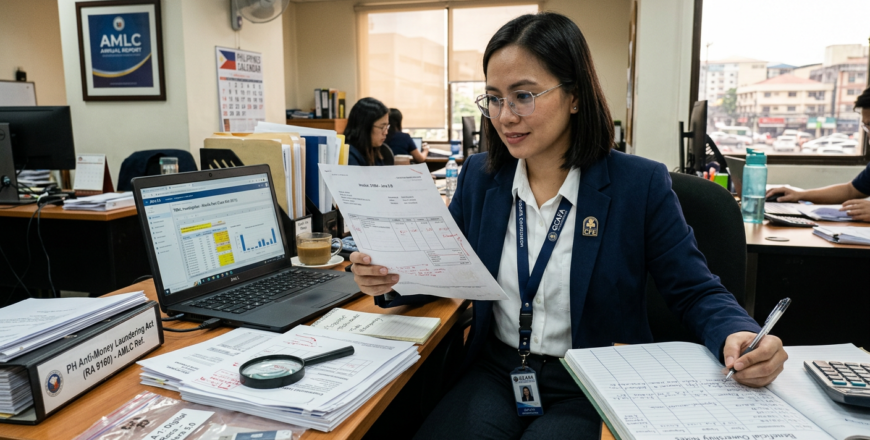
The Greyhawk Certified Accounting Fraud Analyst (GCAFA) is a comprehensive professional certification program offered by Greyhawk Manila, designed for criminology graduates, accountants, auditors, compliance officers, investigators, and law enforcement personnel seeking specialized knowledge and practical skills in detecting, analyzing, investigating, documenting, and reporting accounting and financial fraud within the Philippine and APAC context.
The program integrates forensic accounting, fraud examination, financial analysis, digital forensics, evidence management, investigative interviewing, cross-border fraud investigation, agency coordination, case management, and professional reporting into a unified investigative framework.
GCAFA combines structured lectures, practical exercises, simulated investigations, case analysis, digital evidence examination, investigative workshops, and a comprehensive capstone case. Participants progressively develop the ability to move from an initial fraud allegation to a structured investigation, evidence correlation, findings assessment, and professional case presentation.
The curriculum is designed with consideration of the Philippine legal and regulatory environment, while incorporating relevant international investigative concepts and APAC financial crime considerations. Participants are introduced to the roles and coordination considerations involving Philippine institutions and authorities, including the AMLC, SEC, DOJ, PNP, and NBI, while recognizing that legal authority and procedural requirements depend on the specific circumstances of each case.
Important Notice to All Participants
The Greyhawk Certified Accounting Fraud Analyst (GCAFA) is a professional certification and training program focused on accounting fraud analysis, financial investigation, forensic accounting concepts, digital evidence integration, and investigative case management.
Participants are expected to complete all required modules, practical activities, assessments, and the Project Amanat Capstone Case Study to qualify for certification.
The GCAFA credential recognizes successful completion of Greyhawk Manila's professional certification program within its defined educational and competency scope. It should not be represented as a government-issued license, professional statutory license, or authorization to exercise governmental investigative powers.
Greyhawk Manila reserves the right to update course content, assessment procedures, schedules, and certification requirements when necessary to maintain program quality and relevance.
| Course | Greyhawk Certified Accounting Fraud Analyst (GCAFA) |
|---|---|
| Provider | Greyhawk Manila |
| Course Type | Professional Certification Program |
| Level | Intermediate to Advanced |
| Modules | 10 Modules |
| Delivery | Online / Blended Learning |
| Learning Format | Lectures, Case Studies, Practical Exercises, Workshops, Simulation & Capstone |
| Focus | Accounting Fraud, Financial Investigation & Digital Evidence |
| Context | Philippine & APAC Financial Crime Environment |
| Capstone | Comprehensive Accounting Fraud Investigation |
| Certification | Greyhawk Certified Accounting Fraud Analyst (GCAFA) |
| Target Participants | Accountants, Auditors, Criminology Graduates, Investigators, Compliance Officers, Law Enforcement & Related Professionals |
| Prerequisites | Basic accounting, financial, investigative, or related professional knowledge |
| Assessment | Practical Activities, Assessments & Capstone Case Study |
| Final Requirement | Successful completion of Modules 1–9 and certification requirements |
| Website | Greyhawk Manila / Greyhawk Forensics |
To enroll in and successfully complete the Greyhawk Certified Accounting Fraud Analyst (GCAFA) program, participants should meet the following requirements.
Applicants should preferably have one or more of the following backgrounds:
The program is suitable for professionals working in or aspiring to work in:
Participants should have:
Additional software or laboratory access may be provided or specified by Greyhawk Manila for particular practical exercises.
Participants are expected to have basic familiarity with:
Advanced accounting, forensic, or digital-forensics experience is not necessarily required, as these competencies are developed progressively throughout the program.
To qualify for GCAFA certification, participants must:
The capstone is a mandatory component of the GCAFA program.
Participants must demonstrate the ability to:
Plan → Gather → Preserve → Analyze → Correlate → Evaluate → Report → Present
Failure to demonstrate the required competency may result in remediation or reassessment in accordance with the program's assessment policy.
Participants are expected to maintain professional standards throughout the program, including:
Participants must understand that GCAFA training does not independently grant authority to:
Where legal authority is required, participants must follow the applicable process and coordinate with the appropriate authorized authority.
A participant becomes eligible for the Greyhawk Certified Accounting Fraud Analyst (GCAFA) credential upon successful completion of the prescribed coursework, assessments, practical requirements, capstone investigation, and final certification requirements.
Recommended minimum standard: Participants should achieve the program's established passing score and demonstrate competency across the required practical and capstone components.
Important: Completion of the course and issuance of the GCAFA credential signifies successful completion of the Greyhawk Manila certification program within its defined scope. It should not be represented as a government-issued license or as independently conferring legal investigative authority.
The GCAFA program is particularly suitable for:
Prior professional experience in accounting or investigation is beneficial but the program is structured to progressively develop the required competencies.

An introduction to accounting fraud, focusing on the three primary categories: financial statement fraud, asset misappropriation, and corruption. Learners will examine how each type occurs, common warning signs, and its potential impact on organizations.
Introduces the three conditions that commonly contribute to fraudulent behavior: Pressure, Opportunity, and Rationalization. Learners will analyze a case study and map each factor to identify how fraud can develop within an organization.
Introduces common fraud schemes encountered in Philippine organizations, focusing on procurement fraud, payroll fraud, and financial statement manipulation. Learners will analyze real-world scenarios in groups, identify red flags and control weaknesses, and discuss appropriate investigative approaches.
Examines the financial and operational impact of fraud on Philippine organizations, including direct financial losses, investigation costs, business disruption, reputational damage, and recovery expenses. Learners will review available fraud statistics and discuss how fraud trends can influence organizational risk management and internal controls.
Introduces the Anti-Money Laundering Act of 2001 (RA 9160) and its role in preventing and detecting money laundering in the Philippines. Learners will examine covered institutions, covered and suspicious transactions, reporting obligations, and the responsibilities of organizations involved in AML compliance.
Reviews key Bangko Sentral ng Pilipinas (BSP) circulars and regulatory requirements relevant to fraud risk management in supervised financial institutions. Learners will examine how BSP requirements address internal controls, risk management, fraud prevention, detection, reporting, and institutional accountability.
Introduces key Securities and Exchange Commission (SEC) requirements governing corporate financial reporting in the Philippines. Learners will review PFRS-based financial statements, SEC reportorial requirements, audited financial statements, required disclosures, and filing obligations, with emphasis on how financial-reporting requirements help identify potential misstatements and fraud indicators.
Introduces the National Privacy Commission (NPC) guidelines relevant to handling personal and sensitive information during fraud investigations. Learners will examine lawful data collection, access, processing, evidence handling, confidentiality, and privacy safeguards when conducting accounting and digital investigations.
Provides a practical introduction to preparing simulated transaction and incident reports within a fraud-investigation context. Learners will review required information, document suspicious activity, organize supporting details, and complete a simulated CTReport while applying appropriate reporting and documentation procedures.
Introduces a structured approach to identifying, assessing, and prioritizing fraud risks using the COSO framework. Learners will examine how organizations identify risks, evaluate their likelihood and impact, assess existing controls, and determine appropriate responses to significant fraud risks.
Introduces four major categories of organizational fraud risk: Financial, Operational, IT, and Compliance. Learners will examine how fraud can arise within each category, identify common risk indicators, and understand how different risk areas can interact to create broader organizational exposure.
Teaches learners how to evaluate key internal controls, focusing on segregation of duties, authorization and approval procedures, and financial reconciliations. Learners will identify control weaknesses and assess how effectively existing controls prevent or detect potential fraud.
Teaches learners how to construct a fraud risk matrix by assessing identified risks according to their likelihood and potential impact. Through a group exercise using a mock company, learners will prioritize risks, identify critical control gaps, and determine which fraud risks require immediate attention.
Introduces 10 common behavioral warning indicators that may be associated with increased fraud risk. Learners will examine changes in behavior, work patterns, and attitudes that may warrant further inquiry while recognizing that behavioral indicators alone do not establish fraud.
Introduces common transaction-level warning indicators that may signal unusual or potentially fraudulent activity. Learners will practice recognizing patterns such as duplicate transactions, unusual amounts, timing anomalies, round-dollar transactions, and unexpected transaction relationships through a structured pattern-recognition exercise.
Introduces basic analytical techniques used to identify unusual financial activity, including trend analysis, ratio analysis, and gap analysis. Learners will compare financial data, identify unexpected changes or inconsistencies, and determine which findings may require further investigation.
Introduces Benford’s Law as a statistical screening technique for identifying unusual numerical patterns that may warrant further examination in financial data. Learners will test a sample dataset, compare observed and expected leading-digit distributions, and interpret potential anomalies while understanding the limitations of Benford’s Law as a fraud-detection tool.
Introduces the APAC and Philippine cross-border financial crime environment, focusing on how fraud schemes can operate across multiple jurisdictions, financial institutions, and business entities. Learners will examine common cross-border risk factors, international transaction patterns, and challenges faced when identifying and investigating transnational fraud.
Introduces Trade-Based Money Laundering (TBML) and how legitimate trade transactions can be manipulated to disguise or transfer illicit value. Learners will analyze invoices, purchase orders, shipping documents, and payment records to identify inconsistencies, unusual pricing, duplicate documentation, and other transaction anomalies that may warrant further investigation.
Introduces the use of entity and relationship mapping to identify connections among companies, owners, directors, suppliers, customers, and other relevant parties. Learners will analyze corporate relationships and transaction links to identify potential conflicts of interest, undisclosed related parties, unusual ownership structures, and connections requiring further investigation.
Introduces the process of tracing financial transactions across multiple accounts, entities, and jurisdictions to understand how funds move through a cross-border transaction chain. Learners will analyze a simulated fund flow, identify transaction links and counterparties, and document unusual movements, relationships, and potential investigative red flags requiring further examination.
A practical group exercise where learners integrate the cross-border fraud concepts covered in Module 5 to analyze a simulated case. Teams will identify transaction and entity red flags, trace relevant fund flows, evaluate supporting evidence, and deliver a brief investigative assessment with preliminary findings and recommended next steps.
Introduces the fundamental concepts of digital evidence and its role in forensic accounting investigations. Learners will examine common sources of digital evidence, including computers, mobile devices, emails, cloud systems, accounting applications, digital documents, and system logs, while learning how relevance, integrity, authenticity, and context affect the evaluation of digital evidence.
Introduces the principles of digital evidence preservation and chain of custody, focusing on maintaining evidence integrity, authenticity, security, and traceability throughout an investigation. Learners will practice identifying, documenting, labeling, handling, and tracking evidence from initial collection through examination and secure storage.
Introduces the fundamental principles of forensic acquisition of digital evidence, including the creation of forensic copies, preservation of original evidence, integrity verification, and proper acquisition documentation. Learners will observe a demonstration of an evidence-acquisition process and examine how hash verification and controlled procedures help establish the integrity and traceability of acquired evidence.
Introduces the examination of digital artifacts relevant to forensic accounting investigations, including files, metadata, electronic communications, and system-generated records. Learners will conduct a hands-on review to identify relevant information, timestamps, user activity, document history, and potential inconsistencies that may help corroborate financial transactions and investigative findings.
Teaches learners how to combine and compare digital evidence with financial and accounting records to establish timelines, identify inconsistencies, and strengthen investigative findings. Through a practical exercise, learners will correlate digital artifacts, communications, system records, transactions, invoices, and bank records to determine what the evidence supports and what requires further investigation.
A practical group exercise where learners apply the principles of digital evidence preservation, artifact examination, and evidence correlation to a simulated accounting-fraud case. Teams will analyze digital and financial evidence, identify key inconsistencies and red flags, establish a timeline, and present a concise evidence-based investigative briefing with recommended next steps.
Introduces Jera 5.0 and its role in forensic accounting case management. Learners will explore the platform’s core case-management workflow, including case creation, investigation organization, evidence tracking, task management, activity documentation, and case status monitoring. The lesson establishes how Jera 5.0 can support a structured and traceable investigation from case intake through reporting.
Provides hands-on training in creating and initiating a GCAFA investigation case in Jera 5.0. Learners will practice entering essential case information, defining the initial investigation scope, recording the reported issue, assigning case details, and establishing an organized case record for subsequent evidence review and investigative activities.
Teaches learners how to organize, classify, document, and manage investigative evidence and case documents in Jera 5.0. Through a practical exercise, learners will establish a structured evidence record, link documents to the appropriate case, maintain traceability, and ensure that supporting materials are properly organized and accessible throughout the investigation lifecycle.
Introduces the use of Jera 5.0 to create, assign, prioritize, and monitor investigative tasks throughout a GCAFA case. Through a hands-on exercise, learners will practice assigning responsibilities, updating task status, recording investigative activities, and maintaining a clear audit trail of work performed and outstanding actions.
Provides a concise final review of the simulated GCAFA case in Jera 5.0, focusing on evidence, completed investigative tasks, outstanding issues, and preliminary findings. Through a group briefing, learners will present the case status, key observations, evidence gaps, and recommended next steps in a clear and evidence-based format.
Introduces the fundamentals of planning and defining a forensic accounting investigation. Learners will examine how to establish clear investigative objectives, define the scope and boundaries of the case, identify key issues, and develop focused investigative questions to guide evidence collection and analysis.
This lesson introduces a systematic approach to identifying, prioritizing, and obtaining evidence during financial and fraud investigations. Learners will examine documentary, digital, testimonial, and physical evidence sources and evaluate the appropriate acquisition strategy for each. The lesson also introduces Philippine investigative and legal mechanisms relevant to obtaining records, including subpoena duces tecum, search warrants, and AMLC information requests.
Develops learners’ ability to analyze and correlate financial, digital, and investigative evidence to identify relationships, inconsistencies, patterns, and significant investigative issues. Through a workshop, learners will compare multiple evidence sources, establish connections and timelines, and develop objective, evidence-based observations to support the investigation.
This lesson develops practical interviewing skills for financial and fraud investigations. Learners will examine interview preparation, structured questioning, documentation, witness and subject interviews, and techniques for managing difficult interview situations. The lesson emphasizes information gathering, procedural fairness, accurate documentation, and legal compliance.
Teaches learners how to evaluate investigative evidence and develop objective, evidence-based findings. Through a practical exercise, learners will assess the reliability, relevance, and consistency of evidence, distinguish facts from observations and assumptions, identify supporting or contradictory information, and formulate defensible preliminary findings based on the available evidence.
This lesson introduces the principles of coordinating fraud and financial investigations with Philippine government agencies and regulatory bodies. Learners examine the roles of the PNP-CIDG, NBI, AMLC, SEC, and DOJ, including when agency involvement may be appropriate, what information or authority may be required, and how investigative interactions should be documented.
The lesson emphasizes that investigators must work within their legal authority, preserve evidence integrity, avoid duplicating or interfering with official investigations, and properly document all agency coordination.
Introduces the process of preparing a structured preliminary investigation report that clearly communicates the case scope, evidence reviewed, investigative activities, key observations, findings, limitations, and recommended next steps. Through a workshop, learners will organize their case information into a clear, objective, and evidence-based report suitable for review and further investigation.
The Capstone Case Study serves as the integrative culmination of the GCAFA program. Participants apply the knowledge, investigative techniques, analytical methods, digital forensics concepts, and reporting skills developed throughout Modules 1–8 to a comprehensive simulated accounting fraud investigation set in the Philippine context.
The capstone is structured as a guided investigation simulation that follows the complete case lifecycle—from initial case intake and investigation planning through evidence gathering, financial analysis, digital evidence integration, findings development, report preparation, and presentation.
Participants will be required to make investigative decisions, evaluate competing evidence, identify evidence gaps, coordinate investigative activities, and produce a professional investigation package. The exercise emphasizes synthesis and professional judgment, requiring participants to integrate accounting analysis, fraud examination, digital forensics, evidence management, legal considerations, and investigative methodology into a coherent case assessment.
Credit Hours: 8 Hours, including Lab Session
Prerequisites: Completion of Modules 1–8
Delivery: Guided Simulation + Individual Work + Laboratory Exercise + Peer Review
A mid-sized Philippine manufacturing company has reported a series of financial irregularities involving procurement transactions, supplier payments, accounting adjustments, and potentially unauthorized fund transfers.
The company's management initially identified discrepancies during an internal financial review. Several transactions appear inconsistent with normal procurement procedures, while certain supporting records contain unexplained differences.
The preliminary information indicates that the matter may involve multiple related investigative issues, including:
The case requires participants to determine what happened based on the evidence rather than assuming that every irregularity represents fraud.
Successful completion of the GCAFA program culminates in a formal Graduation and Certification stage. This final component recognizes participants who have completed the required instructional modules, practical exercises, investigations, assessments, and capstone requirements.
Graduation is intended to confirm program completion and demonstrated competency within the scope of the GCAFA training program.
