Greyhawk APAC Forensics Practitioner Certification (GAP-FPC) The only hands-on, APAC-aligned digital forensics certification built for practitioners, powered by proprietary AI and real field frameworks.
Most global digital forensics certifications (GIAC GCFA, IACIS CDFE) are designed for US/EU legal frameworks, cost $3,000–$7,000, charge extra for lab access, and prioritize multiple-choice test prep over real-world field skills. The GAP-FPC is built exclusively for APAC practitioners, featuring region-specific legal content, 20+ guided hands-on labs hosted on the Greyhawk Valhalla Lab environment, and a 92% first-time pass rate for students who complete all coursework.
This full 4-module Mastery LMS bundle covers 100% of the content tested on the official GAP-FPC initial certification exam, and aligns directly to Parts 1–4 of the standalone GAP-FPC 150-Question Validation Exam (for low-cost recertification via the Greyhawk Ecosystem, requiring no full course retake). All content is developed by Greyhawk Manila’s elite Digital Forensics and Incident Response (DFIR) practitioners. Drawing from active, high-stakes casework across 9 countries, corporate fraud investigations, and cross-border eDiscovery, the curriculum integrates cutting-edge proprietary systems—including Jera 5.0 AI Crime Profiler, Greyhawk Captain Forensics, Greyhawk Hawk-Eye AI, and the Greyhawk Forensic & Counsel Suites—all while remaining rigorously aligned to NIST SP 800-86, ISO/IEC 27037, and local APAC evidence laws.
ATTENTION ALL PRACTITIONERS AND CANDIDATES
This notice outlines the operational requirements, curriculum modules, and post-graduation access structure for the Greyhawk APAC Forensics Practitioner Certification (GAP-FPC) and the Valhalla Virtual Learning Environment (VLE).
Upon passing the GAP-FPC certification, graduates receive 6 months of access to over 20 hands-on labs hosted directly within the Valhalla Virtual Learning Environment (VLE).
The curriculum is designed exclusively by APAC practitioners for APAC practitioners, replacing generic Western scenarios with regional legal statutes, localization hurdles, and cross-border protocols.
Lab 1 (Singapore Evidence Act Section 10 Decryption Simulation): Execute proper legal-request workflows and technical interactions for compelled decryption orders in criminal cases without violating procedural safeguards.
Lab 2 (India IT Act Section 65B Certificate Generation): Draft, verify, and digitally sign contemporaneous Section 65B certificates during a simulated digital seizure to guarantee admissibility under Indian courts.
Lab 3 (ASEAN MLAT Cross-Border Routing Exercise): Navigate multi-jurisdictional evidence requests through central authorities (e.g., Singapore AGC) and format certified proofs of authenticity for cross-border sharing.
Lab 4 (Regional Mandatory Reporting Triage): Run live ethical decision trees handling statutory overrides, including CSAM discovery, South Korea's National Security Act triggers, and active violence threats.
Lab 5 (Australian Plain-Language Summary Drafting): Convert complex hexadecimal and file-carving logs into a strict, executive-ready page-one plain-language summary tailored to Australian and regional judicial standards.
Lab 6 (ACPO Principle Enforcement & Write-Blocking): Deploy hardware and software write-blockers on live physical acquisitions to ensure absolute compliance with evidence integrity standards.
Lab 7 (Live Environment Documentation & Volatile Capture): Photograph physical setups, note power status, record open applications, and perform RAM acquisition prior to initiating device shutdowns.
Lab 8 (Bit-for-Bit Forensic Imaging & Hash Verification): Execute raw/E01 image extractions using FTK Imager and record SHA-256 cryptographic hashes to verify complete data parity.
Lab 9 (Windows BitLocker & Key Extraction from RAM): Locate and carve volatile encryption keys out of memory dumps to decrypt full-disk encrypted endpoints without altering file systems.
Lab 10 (Linux & macOS Live Triage in Corporate Networks): Collect volatile system artifacts, active user sessions, and network routing states on Unix-based enterprise systems.
Lab 11 (Tamper-Evident Packaging & Chain of Custody Logging): Complete end-to-end custody chains, dual-party handoff signatures, and tamper-evident bag sealing protocols designed to survive defense cross-examination.
Lab 12 (Xiaomi and Oppo Physical Mobile Extractions): Bypass OEM-specific bootloaders and execute physical NAND dumps on popular regional mobile hardware variants.
Lab 13 (Alibaba Cloud Storage Artifact Parsing): Extract, parse, and analyze cloud-native logs, object storage structures, and instance metadata originating from dominant regional cloud providers.
Lab 14 (Regional Enterprise PCAP Sanitization & Translation): Capture raw network traffic, filter noise, and compile officially translated log artifacts required for multi-lingual court proceedings.
Lab 15 (iOS SQLite Database Carving for Deleted Messaging Artifacts): Recover deleted chat threads and metadata timestamps from localized mobile application databases.
Lab 16 (IoT & Smart Device Firmware Extraction): Interface with hardware debug ports (UART/JTAG) to dump firmware from compromised regional smart devices.
Lab 17 (Enterprise Ransomware Attribution and Network Isolation): Rapidly sever enterprise network connections within Valhalla VLE to halt lateral movement and document remote-wipe indicators.
Lab 18 (Forensic Tool Version and Methodology Annex Assembly): Build complete reporting appendices documenting tool versions (e.g., Autopsy 4.19), write-blocker serial numbers, and pre/post hash matching validation tables.
Lab 19 (Statutory Compliance Annex for Indian & Singaporean Cases): Bundle required regional statutory declarations and compliance affidavits into the final technical report structure.
Lab 20 (Objective Technical Writing vs. Advocacy Audit): Review and rewrite biased or speculative investigative reports to ensure statements reflect strictly verifiable facts without siding with prosecution or defense.
Lab 21 (Valhalla VLE Mock Courtroom Cross-Examination): Stand up as an expert witness in a simulated Valhalla VLE courtroom battle, defending chain of custody integrity, hash calculations, and technical findings under aggressive cross-examination.
By the end of this 40+ hour self-paced certification bundle, you will be able to:
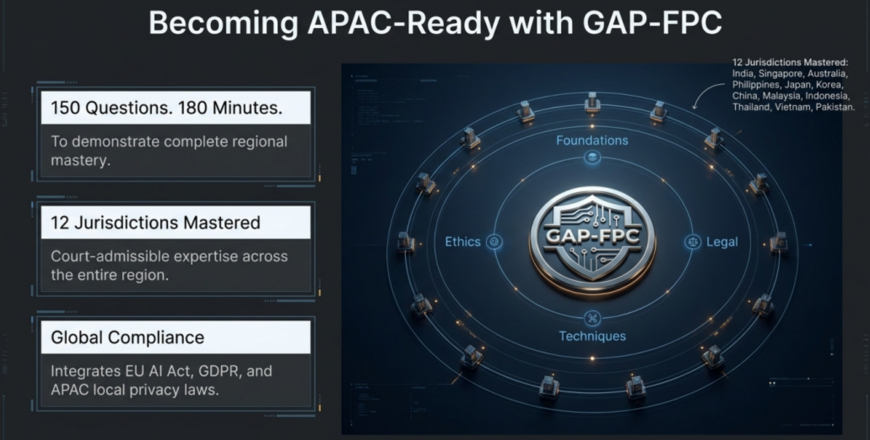
Identify key APAC jurisdictional laws (Singapore Evidence Act, India IT Act Section 65B, Australia Evidence Act 1995, ASEAN MLAT, Philippine Rules on Electronic Evidence) governing digital evidence collection, storage, and admissibility.
Apply cross-border evidence sharing rules to multi-jurisdictional investigations to ensure evidence is admissible across APAC borders.
Maintain an unbroken chain of custody for digital evidence to avoid having critical evidence ruled inadmissible in court.
Leverage the Greyhawk Counsel Suite workflows for secure, audit-ready litigation support and corporate compliance reporting.
Prepare APAC court-compliant expert reports and testimony for digital forensic cases.
Perform disk forensics on NTFS, APFS, and ext4 file systems to recover deleted files, analyze file system artifacts, and identify persistence mechanisms.
Conduct memory analysis with Volatility 3 and Medusa 2.0 subsystems to identify malicious processes, injected code, and command-and-control (C2) configurations.
Extract and analyze mobile device artifacts (iOS/Android) using Cellebrite UFED and Autopsy integrated within the Greyhawk Forensic Suite.
Use write-blockers and forensic imaging tools to preserve original evidence integrity.
Analyze PCAP files with Wireshark to identify indicators of compromise (IoCs), C2 communication, and data exfiltration.
Extract and parse mobile app artifacts (WhatsApp, Telegram, SMS) from Android and iOS devices using next-gen parsing algorithms.
Collect and analyze IoT device data (smart locks, thermostats, wearables, security cameras) for use as admissible evidence.
Deploy Greyhawk Captain Forensics to detect deepfakes, synthetic media, and sophisticated anti-forensics tactics used by attackers to hide activity.
Manage end-to-end digital forensic investigations from evidence collection to court presentation using the Greyhawk Ecosystem Proprietary Platform.
Utilize the Jera 5.0 AI Crime Profiler to synthesize behavioral patterns, correlate threat telemetry, and build comprehensive timelines.
Write expert forensic reports compliant with APAC court rules, including plain-language summaries for non-technical judges and juries.
Testify as an expert witness in APAC courts, including navigating cross-examination and disclosure requirements.
Detail Content
Total Duration 40+ hours self-paced content + 20+ guided labs powered by the Greyhawk Valhalla Lab environment (includes 6 months of full cloud lab access post-enrollment or validation)
Lab EnvironmentGreyhawk Valhalla Lab: A fully provisioned, browser-accessible virtual lab ecosystem pre-configured with Autopsy, Volatility 3, Wireshark, FTK Imager, and the Greyhawk Forensic Suite / Medusa 2.0 modules.
4 Core Modules
• Module 1: APAC Digital Forensics Legal & Ethical Principles (4 hours)
• Module 2: Endpoint, Memory & Storage Forensics (10 hours)
• Module 3: Network, Mobile & IoT Forensics (12 hours)
• Module 4: Case Management, Reporting & Advanced Investigation (14 hours)
Integrated Platforms
Hands-on exposure to Greyhawk Ecosystem Proprietary Platform, Jera 5.0 AI Crime Profiler, Greyhawk Captain, Hawk-Eye AI, Greyhawk Counsel Suite, and Medusa 2.0.Hands-On Labs20+ guided labs using real anonymized APAC case files (e.g., Singapore financial fraud ransomware investigation, Philippine business email compromise (BEC), Australian critical infrastructure ICS attack) via the Greyhawk Valhalla Lab.
Initial Exam120-question proctored exam (included in course fee) with 70% passing threshold, split into 4 sections aligned to each module.
Recertification Official GAP-FPC 150-Question Online Validation Exam ($199 for existing holders, $299 standalone) via the Greyhawk Ecosystem – no full course retake required, 40 CPE credits pending formal approval.
Credential
Official, verifiable GAP-FPC digital badge + public credential registry entry, valid for 2 years, shareable on LinkedIn and confirmable by employers.
CPE Eligibility
Eligible for CPE submission to GIAC, (ISC)², CREST, Singapore SSG, and IACIS with free supporting documentation.
Incident responders and cybersecurity analysts handling cross-border cybercrime, ransomware, and data breach cases.
E-discovery specialists and legal professionals working on APAC litigation, corporate fraud, and regulatory investigation matters.
IT auditors and compliance teams responsible for evidence preservation during internal investigations.
Mid-career forensic practitioners seeking formal, region-aligned certification for promotions or new roles.
Law enforcement forensic officers across APAC jurisdictions who need to ensure evidence is admissible in local courts.
Government security teams requiring APAC-specific forensics training for national security cases.

The Greyhawk APAC Forensics Practitioner Certification (GAP-FPC) is the premier, hands-on digital forensics certification tailored specifically for practitioners operating within the Asia-Pacific region. Powered by proprietary AI methodologies and grounded in real-world regional frameworks, it bridges the gap between technical artifact recovery and complex cross-border legal compliance.

